Eléments de chimie (Structure de la matière)
Topic outline
-

Faculty
Faculty Of Technology
Department
Mechanical Engineering
Target public
First-year mechanical engineering students
Credit
07
Coefficient
04
Duration
15 weeks
Timetable
Sunday:11h30-13h00
Monday: 08h30-11h30
Room
M108
Teacher
Dr BENOMARA Amina
Contact
By e-mail at:
amina.benomara@univ-tlemcen.dz
-

I am available at any time on the forum space of this platform,
Teams messages, and through the email mentioned above
if needed.
-
Chemistry is the branch of science that studies the composition, structure, properties and transformations of matter. It studies the interactions between different substances and the changes they undergo at the molecular and atomic level.
Matter is anything that has mass and occupies space, which includes almost everything we interact with on a daily basis; everything we can smell, touch, taste or feel is made of matter, so the study of chemistry touches on almost every aspect of our daily lives.
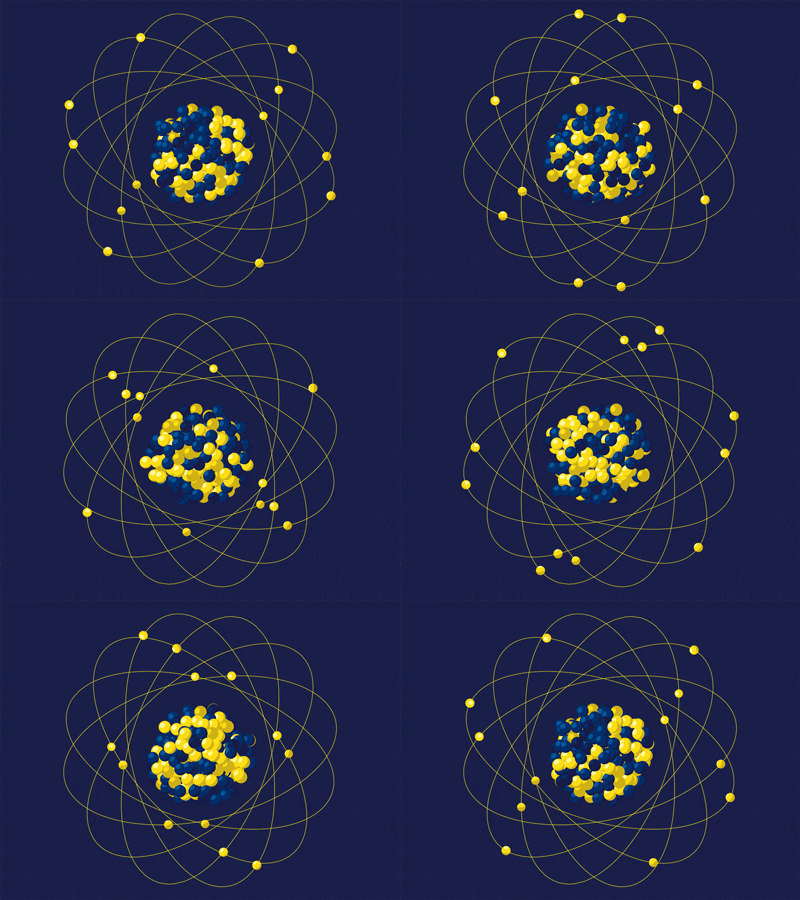
The structure of matter refers to the way in which the elementary particles and basic building blocks of matter are organised. This organisation manifests itself at different scales, from subatomic particles to macroscopic objects.
🎯 Learning Objectives
This module is intended for first-year mechanical engineering students.
Its objectives are to:- Introduce the fundamental concepts related to the structure of matter.
- Develop students’ ability to model and analyze material properties.
📚 Module Structure
The module is organized into three complementary components:
- Courses (C) (1.5 hours per week)
- Presentation of theoretical concepts.
- Explanations supported by diagrams, models, and concrete examples.
- Tutorials (TD) (3 hours per week)
- Practice exercises applying concepts covered in courses.
- Solving practical and theoretical problems.
- Development of scientific reasoning and autonomy.
- Laboratory Work (TP) (2 hours every two weeks)
- Hands-on experiments in the laboratory.
- Observation of studied phenomena.
- Experimental application of theoretical knowledge.
- Development of technical and experimental skills.
-
All the course content is presented in the syllabus.
-
This chapter introduces the basic concepts necessary to understand the nature, behavior, and transformation of matter. It lays the foundation for the study of chemistry and physical sciences by explaining how matter is defined, classified, and conserved during physical and chemical changes.
-
This chapter explores the internal structure of the atom and the experimental discoveries that led to the modern understanding of atomic structure. It introduces the fundamental subatomic particles, the organization of the nucleus, and the identification of chemical elements.
-
This chapter focuses on the interaction between atoms and electromagnetic radiation and explains how atomic emission spectra provided key evidence for the quantized nature of atomic energy. It presents the experimental observations and theoretical models that led to the development of modern atomic theory.
-
This chapter introduces Mendeleïev’s periodic table and explains how the physical and chemical properties of elements vary periodically with atomic structure. It highlights the organization of elements into families and the significance of periodic trends.
-
This chapter examines covalent bonding from classical and modern perspectives. It explains how atoms share electrons to form molecules, how bond polarity arises, and how molecular geometry and quantum theory contribute to the understanding of chemical bonds.
-
This chapter introduces the phenomenon of radioactivity and explains the fundamental processes governing nuclear transformations. It covers both natural and artificial radioactivity, as well as the laws that describe radioactive decay and nuclear reaction kinetics.
-
-