Anglais scientifique
Aperçu des sections
-

Teacher: Mahboubi Salamet
Contact: geology.tlemcen2022@gmail.com
Coefficient: 1
Credits: 2
Evaluation method: exam
-
 This course aims in helping the students:
 • To know the basic of geology, its scope and its various branches
• To introduce fundamental aspects of Earth and its related changes with time.
• To know the various processes of weathering and the processes resulting in their formation of soil
- To understand composition of various minerals, rock and their properties.
- To develop a skills for application of geology to engineering problems.
-
- Understand the fundamental of geology.
- Learn about the magmatic differentiation processes,
- Understand the diversity of igneous rocks and the variety of tectonic environments for their emplacement,
 Understand the petrogenesis of igneous rocks
-
 Chapter 1: The rock cycle
 Chapter 2: Sedimentary rocks and structures
Chapter 3: Ground water
Chapter 4: Mineralogy
References
-
Weathering decomposes bedrocks. Flowing water, wind, gravity, and glaciers then erode the decomposed rocks, transport them downslopes and finally deposit them on the sea coast. Finally, the loose sediment is cemented to form hard sedimentary rock. Sedimentary rocks make up only about 5 percent of the Earth’s crust, but cover about 75 percent of the surface of the continents.
-
S’ouvre : vendredi 15 septembre 2028, 16:15Se termine : lundi 13 novembre 2028, 16:15
-
La phase de remise ouvre : samedi 16 septembre 2028, 11:28La phase de remise ferme : mardi 14 novembre 2028, 11:28
Depositional environments
Geologists study sedimentary rocks to help us understand the past. When geologists study sedimentary rocks, they ask questions such as: Where did the sediment originate? Was the sediment transported by a stream, wind, or a glacier? In what environment did the sediment accumulate?. If it was deposited in the sea, was it on a beach or in deep water? If it was deposited on land, was it in a lake, a stream bed, or a flood plain?
Geologists answer these questions by analyzing the minerals, textures, and structures of sedimentary rocks. Additionally, the size and shape of a sedimentary rock layer contain clues to its depositional environment.Accurate interpretations of depositional environments are often profitable, because valuable concentrations of oil and gas, coal, evaporites, and metals form in certain types of environments. Depositional environments vary greatly in scale, from an entire ocean basin to a 3-meter-long sand bar in a stream. Many small-scale environments may be active within a single large-scale depositional system

-
TECHNICAL WORDS:
1. ground water
2. percolation
3. fresh water
4. porosity
5. permeability
6. water table
7. saturated zone
8. saturation zone
9. unsaturated zone
10. zone of aeration
11. aquifer
12. well
13. cone of depression
14. subsidence
15. salt-water intrusion
16. cave
17. stalactite
18. stalagmite
-
Ouvert : samedi 25 février 2023, 10:30Terminé : samedi 25 février 2023, 12:00
I will explain the foundations of the discipline that studied aquifers.
-
Ouverture : samedi 16 septembre 2028, 00:00À rendre : jeudi 23 novembre 2028, 00:00
According to the passage, which of the following statements are “true” or “false”
-
-
What is a mineral?
A naturally occurring substance with a characteristic chemical composition expressed by a chemical formula; may occur as individual crystals or may be disseminated in some other mineral or rock. Most mineralogists include the requirements of inorganic origin and internal crystalline structure. Minerals are the building blocks of the Earth. For example, SiO2 is always the mineral quartz which consists of only two elements. A few elements - carbon, for example - are the only components of minerals. Graphite and diamond are composed only of carbon, each with a different architecture. A rock is a solid material that is composed of various minerals. Chemical composition and crystalline structure are the two most important properties of a mineral. They distinguish any mineral from all others.
-
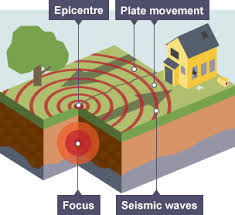
The overall objective is presented in Earthquakes, the main content of this course, which is specifically titled as Familiarity with the origin of earthquakes, types of earthquake waves, and their relationship to plate tectonics. The overall objective of compiling this course is to familiarize students with a number of general terms and terms and key words in geology, as well as to acquire the necessary skills in understanding the content of the English text of the course.
-
An earthquake, or seism, results from the release of energy accumulated by the movement and friction of the different plates of the Earth's crust (phenomena grouped under the name plate tectonics). Most of them are not felt by humans.
-
Complete the list below:
1.earthquake ………………..
2.disaster ………………..
3. seismology ………………..
4. seismologist ………………..
5.predict.......
-
-
Adams, S. and Lambert, D., (2006). Earth Science, An Illustrated Guide to Science. Chelsea House Pub., 208p.
Bates, R. L. and Jackson, J. A., (1980). Glossary of geology. McGraw-Hill Pub., 751p.
Crawford, M. J., (1998). Physical geology. Cliffs notes Pub., 242p.
David Harding, Moira Johnston (Editorial directors), (2006). The Facts On File Earth Science Handbook, Revised Edition, Facts On File, Inc., 272p.
Elizabeth Geller, (Managing Editor), (2003). McGraw-Hill Dictionary of Earth Science, Second Edition, McGraw-Hill Pub., 468p.
